Europe starts with a smart move
Greek Residency - Nobility Residency
Greek Residency is more than a legal permit. It is a strategic decision about mobility, family security, education, lifestyle, asset protection, and long-term stability.
Greek Residency gives non-EU nationals several legal pathways to establish a home, invest, work, study or live independently in one of Europe’s most strategically located countries. Greece combines access to the Schengen Area with an attractive Mediterranean lifestyle, established international schools and a growing environment for investors, entrepreneurs and remote professionals. However, applicants must select a residence category that matches their actual source of income and intended level of physical presence.
There is no single Greek Residency programme for every applicant. A property investor, a financially independent retiree and a highly qualified employee qualify under different provisions and receive different rights. Some permits allow employment while others specifically prohibit it. Some require genuine relocation while the Golden Visa can be renewed without a minimum stay requirement. Understanding these distinctions is essential before transferring funds, purchasing property or submitting an application.
What Is Greek Residency?
Greek Residency is the legal right of a foreign national to live in Greece for longer than the period permitted under a short-stay Schengen visa. For most third-country nationals, the process begins with a national Type D visa or another qualifying basis of entry and continues with an application for a residence permit under the Greek Migration Code.
A Greece Residence Permit is issued for a specific purpose. That purpose may be real estate investment, sufficient independent resources, remote work, employment, highly qualified employment, study or family reunification. The permit’s duration, renewal rules, family eligibility and work rights depend on its category.
The principal framework is Law 5038/2023, Greece’s Migration Code, as subsequently amended, including by Law 5275/2026. The 2026 amendments also reinforce a general three-year validity model for residence permits unless a specific category provides otherwise.
Residency in Greece should not be confused with citizenship. A residence card does not immediately provide a Greek passport or unrestricted settlement rights throughout the European Union. It does, however, create lawful residence in Greece and generally enables short visits within the Schengen Area under the applicable 90-days-in-any-180-days rule.


Main Ways to Obtain Greek Residency
Choosing Greek Residency begins with understanding the legal purpose of each category. The following Greece Residence Permit Types cover the most relevant routes for investors, financially independent applicants, professionals, students and families in 2026.
1. Greek Golden Visa Through Real Estate Investment
The Greek Golden Visa is one of the most recognised routes to Greek Residency for non-EU investors. It grants a renewable five-year residence permit in exchange for a qualifying investment and does not require the investor to reside permanently in Greece.
The principal real estate thresholds are:
- €800,000: Properties in the Region of Attica, Thessaloniki, Mykonos, Santorini and islands with populations exceeding 3,100
- €400,000: Properties in other areas of Greece
- €250,000: A single qualifying property converted from commercial or industrial use into residential use
- €250,000: A listed or protected building that must be restored or reconstructed under the applicable rules
Standard purchases in the €800,000 and €400,000 categories generally require one property with at least 120 square metres of main space. The 120-square-metre condition does not apply to the special €250,000 change-of-use category.
For a converted property, the change of use must be legally completed before the residence application is submitted. In the case of a protected building, completion of the required restoration is normally relevant to the first renewal.
The investor permit is valid for five years and can be renewed for further five-year periods while the qualifying investment is maintained. The main applicant may generally include a spouse or registered partner, qualifying children and the parents of both spouses under the relevant family provisions.
This type of Greek Residency does not grant access to salaried employment. The property must also comply with use restrictions. Properties acquired for the Golden Visa may not be offered as short-term rentals through the sharing economy or subleased. Specific change-of-use properties may not be used as a company’s registered office or branch.
For the investor permit itself, the current government charge is generally €2,000 plus a €16 residence-card printing fee. Legal fees, notary fees, registry costs, taxes, due diligence and property-related expenses must be calculated separately.
2. Residence for Financially Independent Persons
The financially independent route is designed for applicants who can support themselves without working or carrying out an independent economic activity in Greece. It is commonly used by retirees, recipients of foreign rental income, dividend earners and individuals with stable lawful resources.
Under the current rules, the principal applicant must demonstrate at least €3,500 in net monthly resources, equivalent to €42,000 per year. The required amount increases by:
- 20% for a spouse or partner: An additional €700 per month
- 15% for each child: An additional €525 per month
For example, a couple with one child must demonstrate at least €4,725 per month, or €56,700 per year.
Resources may be assessed through recurring foreign income or sufficient legally acquired funds, depending on the structure and quality of the evidence. Pension statements, rental agreements, dividend records, bank statements and tax documents may all be relevant.
Ministerial Decision 225679/2024 establishes the current €3,500 benchmark.
This Greek Residency permit is valid for three years and may be renewed for further three-year periods, provided the applicant continues to satisfy the conditions. Article 163(8) of Law 5038/2023 also allows qualifying family members to receive individual permits expiring with the sponsor’s permit.
Applicants generally begin with a Type D visa, obtain appropriate private health insurance and provide evidence of accommodation and lawful resources. Neither the principal applicant nor dependent family members should rely on this route for employment in Greece.
3. Digital Nomad Visa and Residence Permit
The digital nomad route provides Greek Residency to non-EU employees, freelancers and business owners who work remotely for employers or clients established outside Greece. The applicant must be able to perform the work through digital technology and must not enter the Greek labour market through this category.
The minimum net income is €3,500 per month for the principal applicant. It rises by 20% for a spouse or partner and 15% for each child.
The resulting minimum monthly figures are:
- Principal applicant: €3,500
- Principal applicant and spouse: €4,200
- Principal applicant, spouse and one child: €4,725
- Principal applicant, spouse and two children: €5,250
Applicants should provide an employment contract, service agreements or company documents proving that the professional relationship is with a foreign entity. They must also show that the arrangement will continue during their residence in Greece.
In 2026, applicants should plan to obtain the initial national visa through the appropriate Greek consular authority before completing the residence process in Greece. The residence permit is generally issued for two years and may be renewed for additional two-year periods while the requirements remain satisfied.
The Greek Ministry of Foreign Affairs directs applicants to the official Work From Greece guidance for this route.
This option is particularly relevant when considering How to Get Residency in Greece without buying property. Greek Residency through remote work requires stable foreign income and careful attention to Greek tax and social-security implications.
4. Employment and the EU Blue Card
Non-EU nationals may obtain Greek Residency through employment when a Greek employer follows the required hiring or invitation procedure. Under the standard dependent-employment route, the applicant generally needs an approved employer request and a national visa before applying online for the residence permit.
The employer must first demonstrate that the position and intended recruitment satisfy the relevant admission framework. The employee must then provide the employment approval, contract, valid travel document, insurance evidence and other required documents.
The official registry lists a government cost of €166 for the initial dependent-employment permit and an estimated administrative processing period of approximately 50 to 80 days, although actual timelines may vary. The applicant’s right to work is connected to the category and conditions of the permit.
Highly qualified professionals may instead qualify for the EU Blue Card. Current rules require:
- A highly qualified employment contract lasting at least six months
- Gross annual remuneration equal to at least 1.6 times the average gross annual salary in Greece
- Qualifications or professional experience corresponding to the position
- Recognition or authorisation for regulated professions
- An employer capable of supporting the approved employment arrangement
The exact annual salary amount can change as average Greek salaries are updated, so the threshold should be confirmed immediately before submission.
The EU Blue Card is generally issued for two years and can be renewed for three years. The application fee is €150 plus the €16 card charge and the statutory decision period can be up to 90 days for a complete application.
Unlike investment or financially independent permits, employment-based Residency in Greece gives the holder access to authorised professional activity. Family members of an EU Blue Card holder may also apply through a linked family-reunification procedure.
5. Residence for Study
International students admitted to a recognised Greek higher education institution may apply for a national study visa and then a student residence permit. The applicant must prove:
- Admission to a recognised educational institution
- Enrolment in a specific study programme
- Payment of required tuition or enrolment fees
- Sufficient financial resources
- Appropriate health coverage
- Suitable accommodation where required
Student permits are normally valid for one year and renewable annually. A multi-year permit corresponding to the official length of the programme may be available when the institution certifies the full duration of study.
The government fee is generally €150 for each year requested. Students are permitted to work part-time under the conditions of Greek law.
Student Greek Residency is temporary and education-led. Applicants should not assume that admission automatically creates permanent residence or citizenship. The treatment of study periods for long-term residence and later status changes should be reviewed before relying on this Greek Residency route for a long-term immigration plan.
6. Family Reunification
Family reunification allows eligible relatives of a lawful resident to join or remain with the sponsor in Greece. The definition of eligible family members and the timing of their application depend on the sponsor’s permit category.
Applicants normally need:
- Valid passports
- Legalised and translated marriage or birth certificates
- Evidence connecting them to the sponsor
- Health insurance
- Suitable accommodation
- Proof of sufficient resources where applicable
- Consent or custody documents for minors where required
Additional consent or custody documents may be necessary when a minor is not accompanied by both parents. The family member’s permit generally follows the duration and legal position of the sponsor.
Family members of EU Blue Card holders have a dedicated procedure. The official registry lists €150 for the permit and €16 for card production, with a decision deadline of up to 90 days.
Family reunification is an important Greece Residence Permit for Non-EU Citizens who already have a spouse or parent lawfully established in the country. It is not an independent shortcut and its success depends on the sponsor’s status, resources and continuing compliance.
A small decision, a big start.
With just one click, you will be directly connected to our expert team. We will be happy to host you on your journey to Greece.
Key Points to Consider Before Applying
- Match the permit to the real purpose of residence
- Review the source and continuity of funds
- Complete property due diligence before purchase
- Distinguish residence from tax residence
- Check work rights for both spouses
- Plan renewals from the beginning
- Prepare foreign documents correctly
- Treat citizenship as a separate objective
Top Cities for Greek Residency
For an investor or entrepreneur, selecting a place to live in Greece is not merely a lifestyle choice; it is choosing the “Operational Coordinates” for asset management and business development. Based on economic data analysis and infrastructure potential, the following three cities are recommended as the top destinations to optimize residency and investment:
Athens
As the economic and political center of Greece, Athens plays a key role as a “Strategic Hub” connecting European, Asian, and African (EMEA) markets. Due to massive urban regeneration projects like “Ellinikon” and the development of transport infrastructure, the metropolis is experiencing an “Infrastructure Renaissance,” leading to sustainable growth in the value of commercial and residential real estate in central and coastal areas. From a business perspective, Athens is the best location for entrepreneurs looking for operational scalability in a dynamic, high-traffic ecosystem, thanks to the concentration of international corporate headquarters, access to a wide network of technical talent, and proximity to major ports.








Thessaloniki
As the second-largest economic hub and the “Gateway to the Balkan Market,” Thessaloniki holds a privileged position in the supply chain and logistics of Southeastern Europe. Due to the concentration of universities and research centers, the city has become an emerging center for “Startup Ecosystems” and technology-driven companies, providing an ideal environment for developers and entrepreneurs by leveraging educated labor and optimal “Cost-to-Performance Ratio.” Investing in Thessaloniki means entering a market with rapid growth potential. Beyond its port advantages and high tourism potential, its proximity to developing neighboring markets makes it a strategic choice for businesses looking to expand their operations regionally.
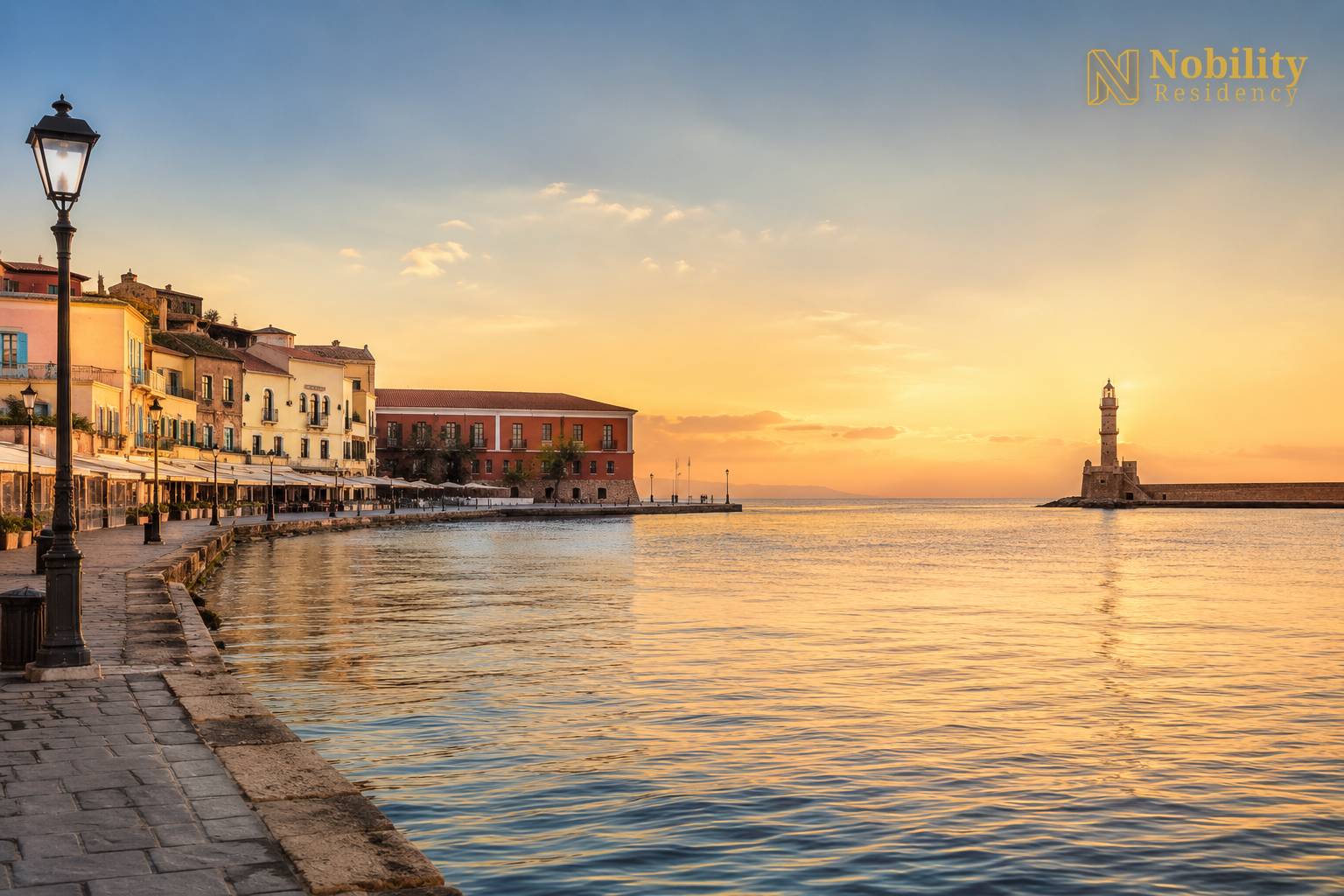
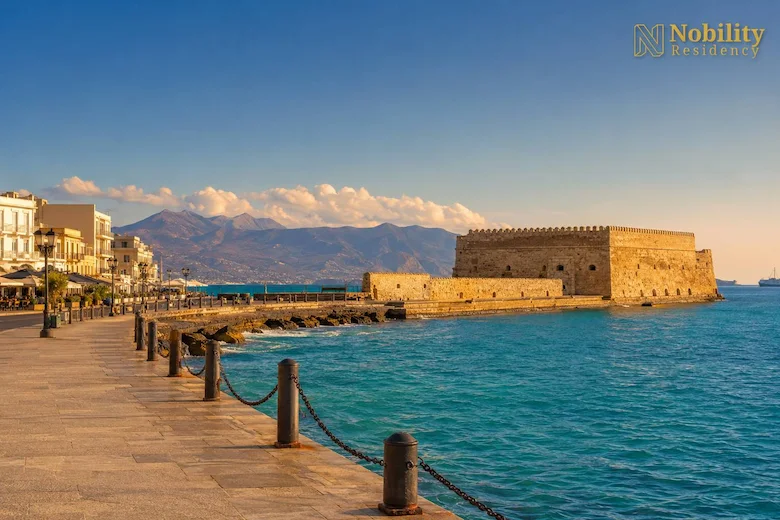
Heraklion (Crete)
Heraklion is not only the primary driver of Greece’s tourism economy but also a stable “Financial Harbor.” It boasts the highest demand for luxury real estate and hospitality. With international infrastructure and strategic ports, the city has created extraordinary potential for investment in “Modern Hospitality” projects and high-yield residential properties with sea views, guaranteed by long-term ROI during peak tourist seasons. For investors seeking a combination of high-quality lifestyle (Lifestyle Investment) and continuous passive income derived from a perpetually growing tourism industry, Heraklion is a final option for stabilizing assets while enjoying the safety and welfare standards of a strategic Mediterranean region.


Benefits of Greek Residency
As one of the strategic Schengen countries, Greece is equipped with unique geopolitical, financial, and structural features that have made it one of the most attractive destinations for international investors, tech entrepreneurs, and families seeking asset protection and long-term security. These premium features include:
- Visa-free access to the entire Schengen Area (29 European countries)
- Lowest tax rates specifically for retirees and high-net-worth immigrants (Non-Dom scheme)
- Lenient regulations with no mandatory continuous physical presence required to maintain investment residency
- Geostrategic position as a transit hub connecting three continents (Europe, Asia, and Africa)
- High capital growth potential in the real estate market compared to Western Europe
- Possibility of including three generations of family members in a single residency application
- Supportive startup and tax ecosystem via the national "Elevate Greece" platform
- Highly competitive operating and utility costs (OPEX) compared to other Eurozone countries
Who Is Greek Residency Suitable For?
Greek Residency may be suitable for:
- Property investors seeking a renewable residence option with limited physical-presence obligations
- Retirees and financially independent individuals with at least €3,500 in qualifying monthly resources
- Remote professionals working for foreign employers or international clients
- Qualified employees who have obtained an eligible position with a Greek employer
- Executives and specialists who meet EU Blue Card requirements
- International students admitted to recognised Greek institutions
- Families joining a sponsor who already holds an eligible status
- Applicants planning genuine long-term relocation who may later pursue long-term residence or naturalisation
- Internationally mobile families seeking a strategic base between Europe, the Mediterranean and the Middle East
The most appropriate Greece Residence Permit for Non-EU Citizens depends on whether the applicant wants flexibility or relocation, whether local employment is required and whether capital or recurring income will support the application.
- Visa-free access to the entire Schengen Area (29 European countries)
- Lowest tax rates specifically for retirees and high-net-worth immigrants (Non-Dom scheme)
- Lenient regulations with no mandatory continuous physical presence required to maintain investment residency
- Geostrategic position as a transit hub connecting three continents (Europe, Asia, and Africa)
- High capital growth potential in the real estate market compared to Western Europe
- Possibility of including three generations of family members in a single residency application
- Supportive startup and tax ecosystem via the national "Elevate Greece" platform
- Highly competitive operating and utility costs (OPEX) compared to other Eurozone countries
FAQ
How much must I invest to receive Greek residency?
For a real estate Golden Visa, the main thresholds are €800,000 in designated high-demand locations, €400,000 elsewhere and €250,000 for specific change-of-use or protected-building investments.
Can I obtain residency without purchasing property?
Yes. Greek Residency may be obtained through sufficient financial resources, remote work, employment, an EU Blue Card, study or family reunification when the relevant conditions are satisfied.
How much income is required for the financially independent route?
The principal applicant needs at least €3,500 per month in qualifying net resources. The amount rises by 20% for a spouse or partner and 15% for each child. A principal applicant with a spouse and two children would therefore need at least €5,250 per month.
Can Golden Visa holders work in Greece?
The investor residence permit does not provide a right to salaried employment. Investors may hold investments and exercise rights consistent with the legal structure, but any intended operational or professional activity requires individual legal analysis.
Final Words
Greek Residency can provide investment flexibility, a Mediterranean base, access to education and a structured path for professionals, retirees and internationally mobile families. Its value, however, depends on choosing the correct route and complying with the conditions attached to that status.
At Nobility Residency, we assess each applicant’s financial profile, family structure, mobility objectives and long-term plans before recommending a programme. Our team coordinates property evaluation, eligibility analysis, document preparation and the residence process with experienced legal and technical professionals.
If you are considering Greek Residency, contact Nobility Residency for a personalized assessment. We can help you compare the available routes, identify legal and financial risks and build a residence strategy designed around your family, investment and future in Europe.